

Laseroptions for MALDI
The performance of a MALDI-TOF mass spectrometer is largely determined by the quality and properties of the laser used. Since sample desorption and ionization are the first and most critical steps of the analysis, the choice of laser source directly influences the sensitivity, mass resolution, and reproducibility of the results.
In modern analytical chemistry, two main concepts are in contrast: the classic nitrogen laser and the high-frequency Nd:YAG solid-state laser. While one is compelling due to its chemical compatibility with standard matrices, the other offers significant advantages in terms of speed and longevity.
The following overview analyses the specific advantages of these laser technologies and explains which properties, from wavelength and beam profile to the type of Q-switching, are crucial for different MALDI applications.
- Nitrogen Laser (337 nm)
This classic laser type is considered a specialist for optimal signal quality when using standard organic matrices.
Improved coupling to matrices: Many common matrices (e.g., CHCA or DHB) have their absorption maximum near 337 nm. This enables efficient energy uptake and gentler ionization, which is particularly important to prevent the damage of sensitive proteins.
Homogeneous beam profile: It often has an irregular, flat beam profile (similar to a “flat-top”). This ensures even energy distribution, promoting homogeneous desorption and preventing local overheating.
Reduced sample damage: Due to the strong absorption, the beam penetrates less deeply into the sample crystal. Precise surface ablation reduces the fragmentation of biomolecules.
Cost efficiency: Nitrogen lasers are technically less complex and usually less expensive to purchase.
- Nd:YAG Laser (355 nm)
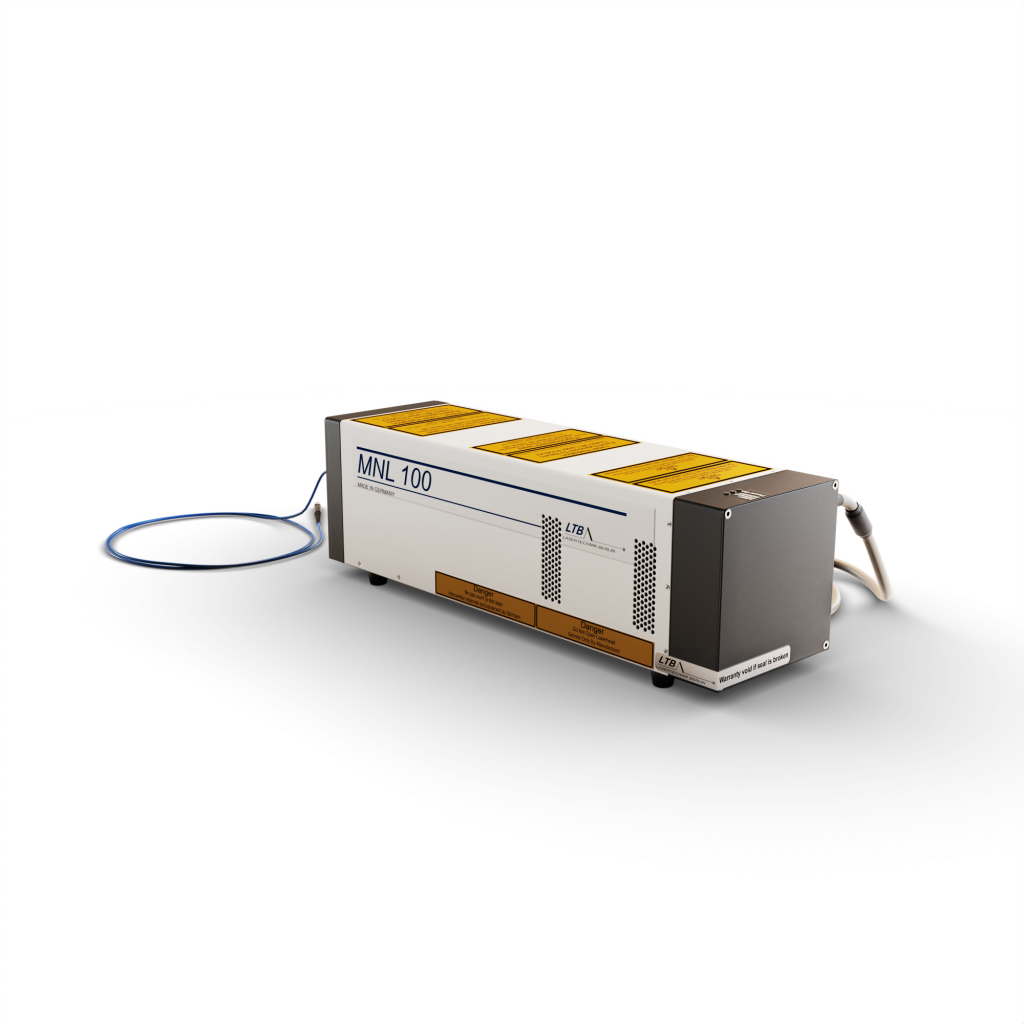
This solid-state laser (with tripled frequency) is the workhorse for high-throughput operation.
Long lifetime: It achieves billions of shots compared to the millions of a nitrogen laser.
Excellent beam quality and focus: It can be focused to a significantly smaller spot, which is essential for high-resolution MALDI imaging (tissue sectioning).
Active Q-switched systems: These offer additional advantages in terms of precision and flexibility:
Precise timing: Time-of-flight (TOF) measurement can be synchronized with the laser pulse to the nanosecond, resulting in higher mass resolution.
Variable repetition rates: Enables extremely fast scanning of sample plates, as the laser triggers flexibly as soon as the sample is in position.
Energy control: The pulse energy can be actively adjusted to the specific sample or matrix.
Modern Solution: Smartbeam Technology
To combine the advantages of both worlds, high-end devices utilize modified 355 nm lasers. Here, the typical Gaussian profile of the Nd:YAG laser (which often leads to destructive “hot spots” in the centre) is artificially transformed into a homogeneous profile. This provides the gentle ionization of the nitrogen laser combined with the speed and longevity of the solid-state laser.
Summary Overview:
Nitrogen laser (337nm) – Signal quality & gentle ionisation speed & lifetime beam profile naturally homogeneous (“flat-top”), complexity Lower, often less expensive
Nd:YAG laser (355nm) Gaussian profile (often with “hot spots”) High throughput imaging , higher complexity (especially with active Q-switching)