

Introduction
In modern material characterisation, echelle spectrometers can play a vital role in analytical instruments. In particular when they must deliver high spectral resolution across broad wavelength ranges without sacrificing speed or optical stability. Traditional linear spectrographs (Czerny-Turner configurations) often force a trade-off: capturing a wide spectral window means lowering detail, whereas zooming in on specific emission lines restricts the field of view.
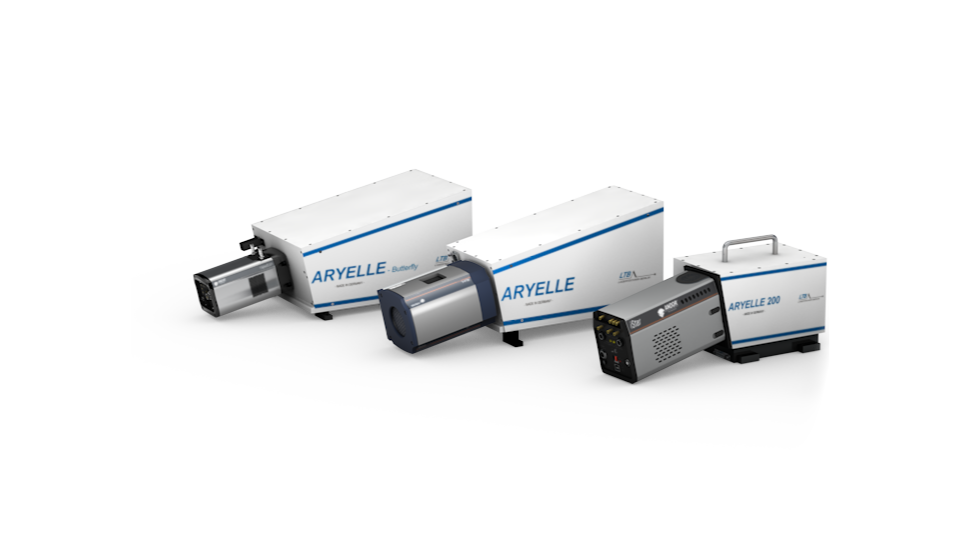
At LTB Lasertechnik Berlin GmbH, we engineer our Aryelle Echelle spectrometers to overcome this exact bottleneck. By utilising two-dimensional spectral dispersion, Echelle optics provide ultra-high resolving power across the entire ultraviolet to near-infrared spectrum (UV-VIS-NIR) in a single shot or time point. This capability opens up critical possibilities for scientific research and industrial diagnostics.
The Optical Architecture of Echelle Spectrometers
The core advantage of Echelle spectroscopy lies in its internal layout. Unlike standard grating spectrographs, an Echelle system incorporates a coarse grating with a high blaze angle, optimised for operating at high diffraction orders. Because these high diffraction orders overlap spatially, a secondary cross-dispersing element, such as a prism, separates the orders perpendicularly.
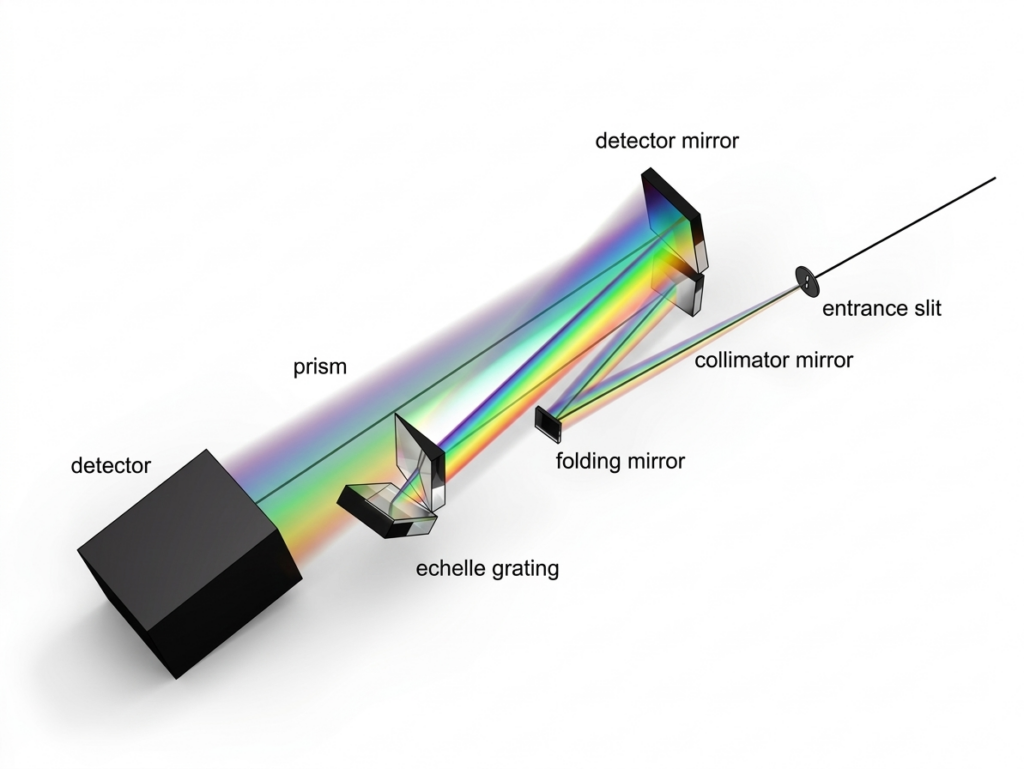
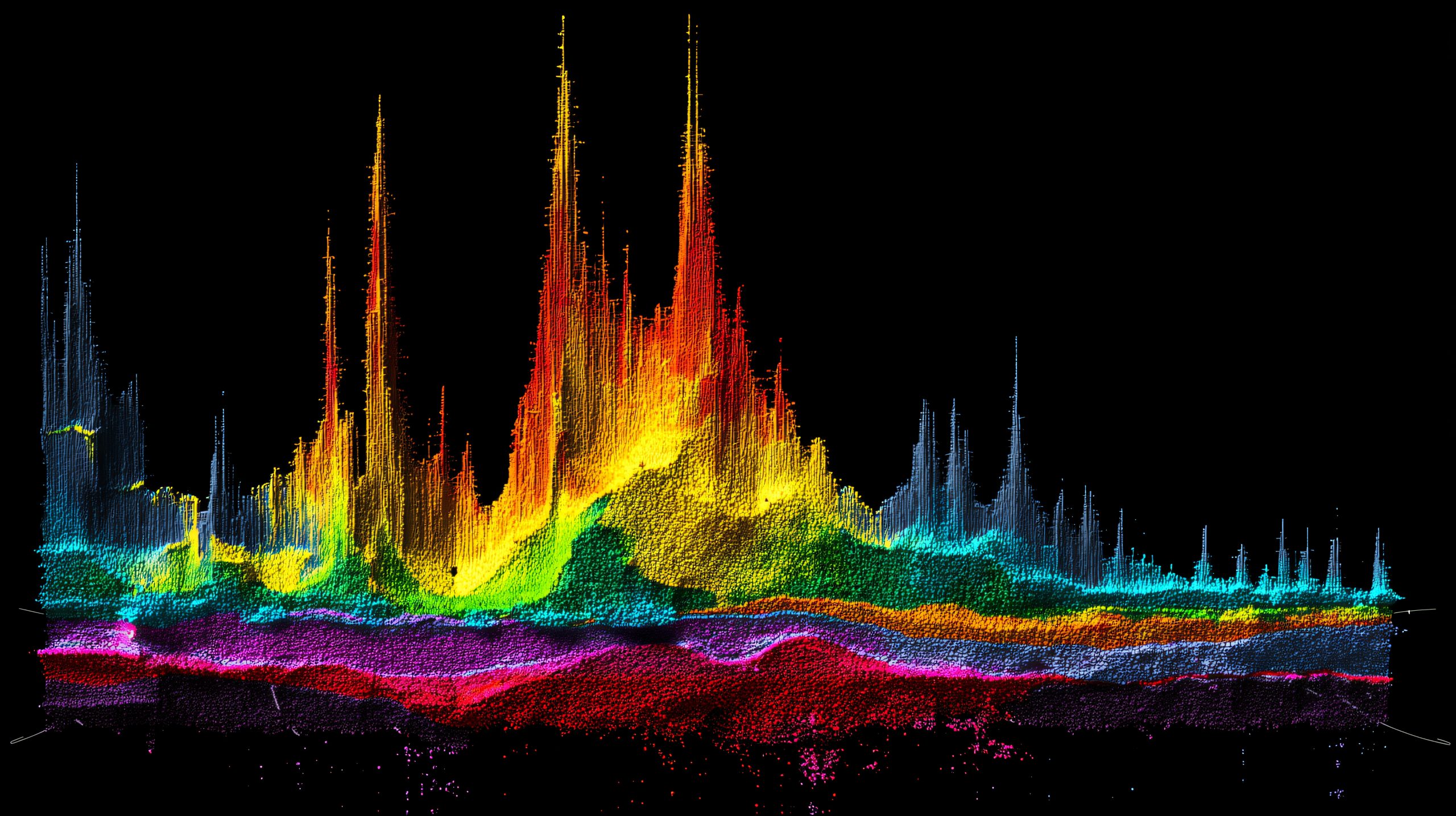
This dual-dispersion process produces a compact two-dimensional spectrum (an echellogram) on a array detector, such as an sCMOS or CCD camera. Instead of spreading light across a meter-long focal plane, ARYELLE spectrometers pack meters of effective optical path into compact instrument housings. LTB’s proprietary Sophi nXt software suite then processes the 2D matrix into a fully calibrated, high-resolution 1D spectrum.
Primary Scientific and Industrial Applications
1. Multi-Element Laser-Induced Breakdown Spectroscopy (LIBS)
Laser-Induced Breakdown Spectroscopy relies on focusing a pulsed laser onto a sample surface to generate a micro-plasma. As the plasma cools, characteristic atomic and ionic emission lines are recorded.
Because a single laser spark excites dozens of chemical elements simultaneously, measuring the plasma emission requires a broad spectral range coupled with high resolving power. The Aryelle spectrometer family satisfies both criteria, making it suitable for:
- Metallurgy & Alloy Verification: Rapid identification of complex trace elements, inclusions, and grade verification in steel, aluminium, and precious metal production.
- Geology & Gemmology: Elemental mapping of minerals, trace-element fingerprinting in gemstones, and origin determination without invasive sample destruction.
- Environmental & Soil Analysis: Real-time detection of heavy metals and pollutants directly in field samples or industrial runoff.
2. Dual/Combined LIBS-Raman Diagnostics
Combining elemental analysis (LIBS) with molecular bond characterisation (Raman spectroscopy) offers complete material identification. In particle analysis, systems like LTB’s CORALIS utilise Echelle spectrometers to evaluate both atomic emissions and vibrational molecular spectra from the exact same spatial point. This method allows researchers to classify organic contaminants, pharmaceutical particulate matter, or microplastics in a single automated workflow.
3. Plasma Diagnostics and Nuclear Fusion Research
In high-temperature plasma research, such as experimental fusion reactors, monitoring impurity transport and plasma-wall interactions requires sub-nanometer spectral resolution. Aryelle spectrometers, including double-Echelle systems like the Aryelle Butterfly, supply the spectral purity required to resolve dense emission lines in extreme environments.
Comparative Advantage of Echelle Systems
| Performance Parameter | Standard Czerny-Turner Spectrograph | LTB ARYELLE Echelle Spectrometer |
| Spectral Coverage | Narrow per grating angle setting | Simultaneous UV-VIS-NIR (e.g., 190–1000 nm) |
| Resolving Power (lambda/ Delta\lambda) | Low to moderate (1,000–5,000) | High to extreme (9,000–50,000) |
| Mechanical Moving Parts | Multiple (rotating gratings, slits) | Minimal to none (staring optical setup) |
| Calibration Stability | Prone to drift over wide scans | Thermally decoupled optical bench for high stability |
By eliminating the need to physically scan gratings across multiple exposures, Aryelle spectrometers capture complete chemical fingerprints in single-shot measurements. This thermal and mechanical stability ensures reliable performance across both laboratory environments and continuous inline industrial processes.