

Short pulse lasers: fundamentals, key parameters and applications
Short-pulse lasers emit light in short, time-limited pulses. This allows energy to be delivered precisely – for example, to excite molecules, perform time-resolved measurements or process materials. The suitability of a laser source is determined primarily by its wavelength, pulse duration, pulse energy and repetition rate.
Learn how short-pulse lasers work, which parameters matter and what distinguishes lasers in the ultraviolet spectral range.
What is a short-pulse laser?
A pulsed laser emits its energy in individual light pulses. A continuous-wave laser, by contrast, emits continuously. Short pulses can achieve high instantaneous power, even when the time-averaged power is comparatively low.
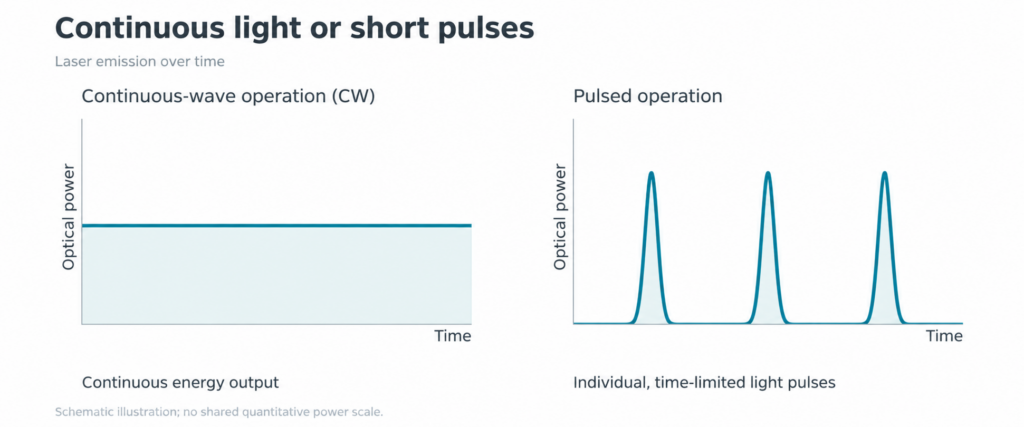
Schematic comparison of continuous-wave and pulsed operation; no shared quantitative power scale.
Short time windows
A laser pulse provides a defined starting point in time. This supports, for example, the synchronisation of excitation and detection.
High peak power
Delivering a given amount of energy in a shorter time increases the power during the pulse. The exact peak power also depends on the temporal pulse shape.
Targeted interaction
Wavelength, pulse energy and focus jointly determine how the light interacts with a sample or material.
Short pulses and ultrashort pulses
Nanosecond lasers are typical short-pulse lasers. Picosecond and femtosecond lasers are generally referred to as ultrashort-pulse lasers. This introduction focuses on nanosecond pulses and, in particular, UV lasers.
Which parameters matter?
A single value provides only a partial description of a pulsed laser. Selection depends on how the parameters interact and how well they match the application.
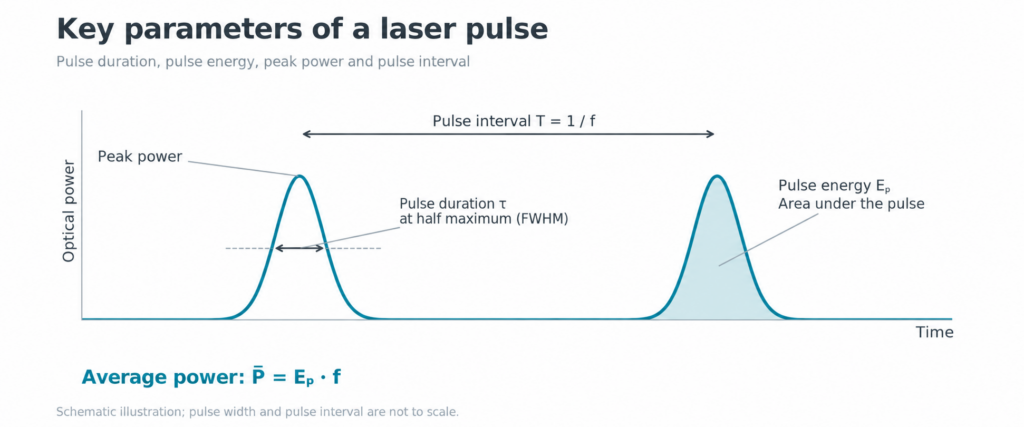
Schematic illustration of a pulse train. Pulse duration is often specified as the full width at half maximum (FWHM). Pulse width and pulse interval are not to scale.
| Parameter | Meaning | What to check when selecting a laser |
|---|---|---|
| Wavelength λ | Determines photon energy and influences absorption by the sample. | Absorption spectrum, optical transmission and coatings. |
| Pulse duration τ | Describes the temporal width of a pulse, often specified as FWHM. | Time course of the interaction and synchronisation with detection. |
| Pulse energy Eₚ | Energy of an individual pulse, often specified in µJ or mJ. | Required energy at the target, adjustment range and optical losses. |
| Repetition rate f | Number of pulses per second. | Measurement speed, sample exposure and data acquisition. |
| Average power P̄ | Power averaged over many pulses. For uniform pulses, P̄ = Eₚ · f. | Power requirements and time-averaged thermal load. |
| Peak power Pₛ | Maximum power during a pulse; order of magnitude Pₛ ≈ Eₚ / τ. | Temporal pulse shape and requirements of the excitation process. |
| Beam profile and spot size | Determine the spatial energy distribution on the sample. | Fluence, focusability and spatial resolution. |
| Pulse stability and triggering | Support reproducible measurements with defined timing. | Energy fluctuations, trigger interfaces, delay and jitter. |
Worked example: low average power, high pulse power
A hypothetical laser delivers 100 µJ per pulse at 1 kHz with a pulse duration of 3 ns.
0.1 W
Average power
100 µJ × 1,000 s⁻¹
approx. 33 kW
Order of magnitude of peak power
100 µJ / 3 ns
1 ms
Interval between two pulses
1 / 1,000 Hz
Illustrative example, not a product specification. A Gaussian pulse with a FWHM of 3 ns has a peak power of approximately 31 kW.
What distinguishes UV short-pulse lasers?
UV light has shorter wavelengths and higher photon energies than visible light. Combined with short pulses, this enables targeted excitation of molecules and the processing of small structures. Suitability depends on absorption behaviour and the intended interaction.
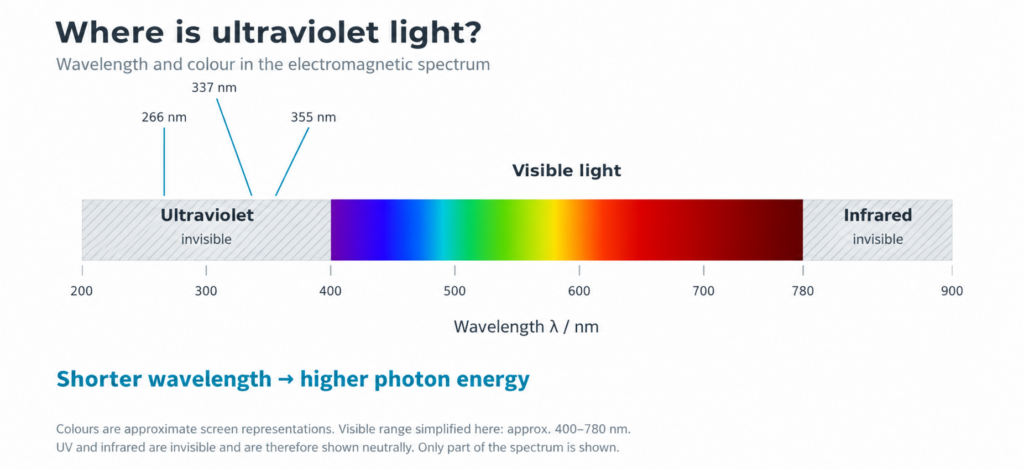
UV in the electromagnetic spectrum. The colour gradient approximates the visible range; UV and infrared are invisible and are shown neutrally.
Targeted excitation of molecules
Many molecules and marker systems absorb in the UV range. The excitation wavelength is matched to the relevant absorption spectrum.
Addressing small structures
Shorter wavelengths allow smaller diffraction-limited focal spot diameters with comparable optics. The actual focus also depends on beam quality and the optics used.
The sample determines the choice.
UV is not the best choice for every measurement task. Key factors include absorption, the required signal strength and potential photochemical or thermal changes. Pulse energy, beam area and repetition rate must also be matched to the sample.
Which laser types generate short UV pulses?
UV pulses can be generated in different ways. Two concepts that are important in analytical applications are nitrogen lasers and frequency-converted solid-state lasers.
Nitrogen lasers
Direct UV emission
An electrical gas discharge excites nitrogen. Laser emission occurs at approximately 337 nm, with pulses typically in the nanosecond range. Nitrogen lasers are established sources for MALDI-TOF and fluorescence applications.
Diode-pumped solid-state lasers
UV through frequency conversion
Laser diodes pump a solid gain medium. Short pulses can be generated by Q-switching. Nonlinear crystals then convert the light into the UV range. Wavelength and operating parameters depend on the design.
Other concepts
Other laser sources can also deliver short UV pulses, including excimer lasers and frequency-converted ultrashort-pulse lasers. Selection depends on the required wavelength, pulse duration, pulse energy and intended operating conditions.
Where are short-pulse lasers used?
Requirements vary depending on the measurement principle. The following examples illustrate applications with a particular focus on UV short-pulse lasers.
MALDI-TOF
A UV pulse is absorbed by a suitable matrix and initiates desorption and ionisation processes.
Key factors: Wavelength, pulse energy, beam profile and stability.
Bioassays and time-resolved fluorescence
Short pulses excite suitable fluorescent markers. Delayed detection can suppress short-lived background signals.
Key factors: Excitation wavelength, timing and reproducibility.
Laser-induced fluorescence (LIF)
Fluorescence following targeted laser excitation provides information about molecules and their environment.
Key factors: Absorption spectrum, pulse duration and synchronisation with detection.
Laser micromachining
Focused pulses locally modify or remove material. The process depends strongly on the material and laser parameters.
Key factors: Fluence, focal spot size, pulse duration and pulse overlap.
What helps when selecting a laser source?
Start by describing the measurement task and the sample. This provides the basis for defining the laser requirements and its integration.
| Selection criterion | Key questions |
|---|---|
| Sample and process | What needs to be excited, measured or processed? Which wavelength is absorbed? |
| Energy at the target | What pulse energy and beam area are required at the sample? What optical losses occur? |
| Timing | What pulse duration, repetition rate and synchronisation does the measurement require? |
| Integration and operation | What are the requirements for installation space, triggering, stability, maintenance and service life? |
UV short-pulse lasers from LTB
LTB develops compact pulsed UV lasers for analytical instruments and OEM systems. Nitrogen lasers and diode-pumped solid-state lasers offer different options for UV excitation with defined timing. The appropriate configuration depends on the sample, the required excitation conditions and instrument integration.
DPSS lasers · 336 nm and 355 nm
qMNL series

Actively Q-switched, diode-pumped solid-state lasers for UV excitation with defined timing. Wavelength and configuration are matched to the instrument requirements.
Nitrogen lasers · 337 nm
MNL 100

Compact nitrogen lasers as pulsed UV sources for analytical measurement setups. An option for instruments whose optics and measurement sequence are designed for excitation at 337 nm.
The right laser source for your instrument
Are you developing an analytical instrument or looking to replace an existing laser source? Discuss the wavelength, pulse energy at the sample, repetition rate, triggering and mechanical interfaces with us.
Frequently asked questions
What is the difference between pulse energy and power?
Pulse energy describes the energy of an individual pulse. For uniform pulses, average power is calculated by multiplying pulse energy by repetition rate. Peak power is the maximum power within a pulse and also depends on pulse duration and pulse shape.
Are short-pulse lasers always UV lasers?
No. Pulsed lasers are also available in the visible and infrared spectral ranges. Pulse duration and wavelength are separate properties of a laser source. This page focuses on short-pulse UV lasers.
Is a shorter pulse duration always better?
No. Pulse duration must be matched to the intended excitation or processing task. At the same pulse energy, a shorter pulse duration typically increases peak power and can change the interaction with the sample.
What is the difference between fluence and intensity?
Fluence is the energy per illuminated area, often specified in J/cm². Intensity is the power per area, often specified in W/cm². For spatially non-uniform beam profiles, local values differ from values averaged over the area.
What information helps with an OEM enquiry?
Useful details include the application, desired wavelength, pulse energy and spot size at the sample, pulse duration, repetition rate and stability requirements. Information about triggering, installation space, beam delivery and interfaces is also important.
All diagrams are original, simplified illustrations.