


MALDI-TOF: UV Laser Pulses for Mass Spectrometry
Short UV laser pulses transfer molecules from a prepared sample into the gas phase and ionise them. A time-of-flight mass spectrometer separates the resulting ions according to their mass-to-charge ratio. The laser source provides the precisely timed excitation pulse.
Learn how MALDI-TOF works, which laser parameters influence the measurement, and what to consider when selecting a UV laser source.
How does MALDI-TOF work?
The name combines two processes: MALDI stands for Matrix-Assisted Laser Desorption/Ionization . TOF stands for Time of Flight: The flight time of the ions allows their mass-to-charge ratio to be determined, expressed as m/z.
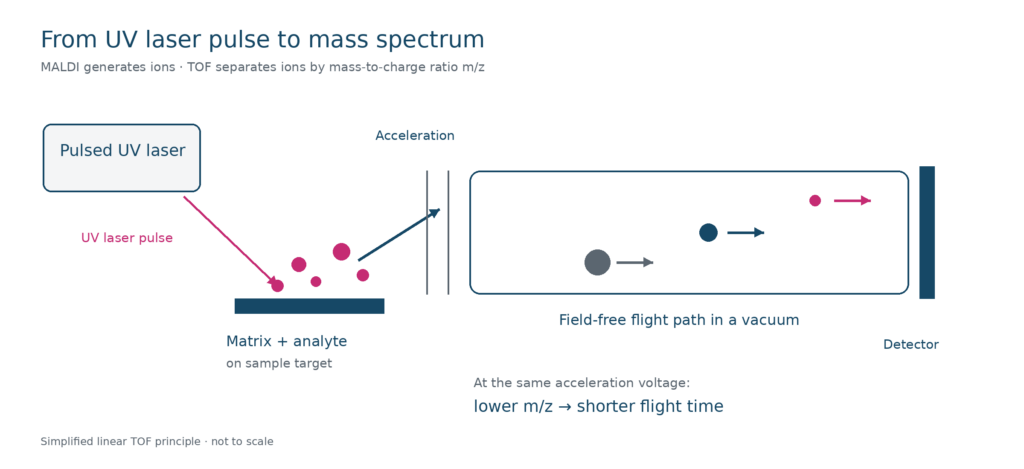
Prepare the sample
The analyte and a suitable matrix are deposited onto a sample target. Many preparation methods produce a crystalline mixture after drying.
Generate ions
The matrix absorbs energy from a short laser pulse. Material is desorbed and some of the analyte molecules are ionised. Suitable conditions allow relatively gentle analysis of large molecules.
Measure the flight time
An electric field accelerates the ions. They are separated according to m/z along the flight path in a vacuum. The detector records the time-dependent ion signal.
What is actually determined?
The instrument first measures flight times. Calibration converts these into mass-to-charge ratios. MALDI often produces singly charged ions; adducts and other charge states must be considered when interpreting the results.
What role does the UV laser play?
The laser delivers energy to a defined area of the sample at a defined time. Many MALDI applications use UV light because suitable matrices absorb in this spectral range. The choice of wavelength therefore also depends on the matrix, analyte and measurement method.
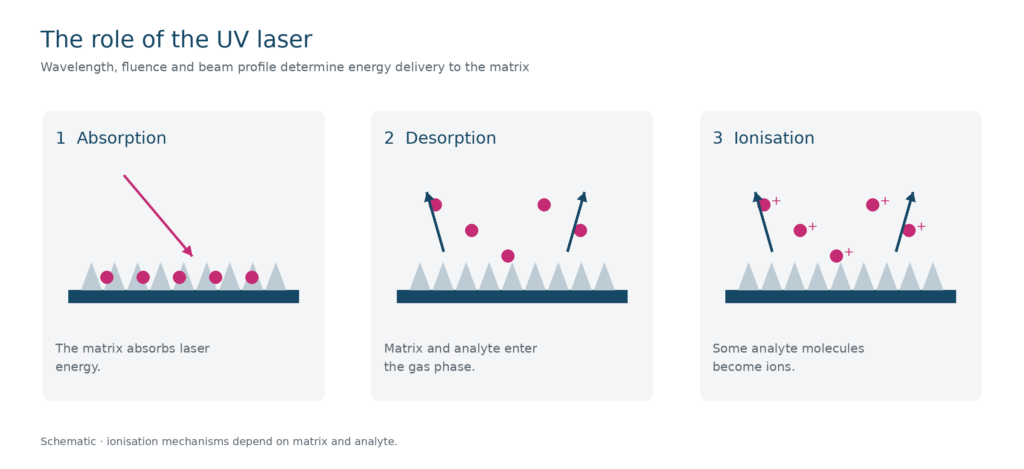
Deliver energy precisely
The key parameter is the fluence on the sample: the pulse energy per irradiated area. Together with the beam profile, it determines which regions of the preparation are excited.
Achieve reproducible excitation
Stable pulses and defined triggering help maintain comparable excitation conditions. Spectral quality also depends on sample preparation, ion optics, the detector and data analysis.
Which laser parameters are important?
A suitable laser source is selected together with the beam delivery, focusing optics and measurement sequence. Pulse energy at the laser output alone does not fully describe the excitation conditions at the sample.
| Parameter | Importance for MALDI-TOF | What to consider |
|---|---|---|
| Wavelength | Influences energy absorption by the matrix. | Absorption of the matrices used and transmission of the optics. |
| Pulse energy and fluence | Determine energy delivery per pulse and per unit area. | Energy at the sample, spot size, adjustment range and optical losses. |
| Pulse duration | Determines the temporal profile of excitation. | Compatibility with desorption, ionisation and measurement timing. |
| Pulse stability | Supports reproducible excitation conditions. | Variations between pulses, measurement series and over operating time. |
| Beam profile and spot size | Determine the spatial distribution of fluence. | Homogeneity, focusing and spatial resolution requirements. |
| Pulse repetition rate | Influences the number of excitation events per unit time. | Compatibility with sample scanning, data acquisition and sample consumption. |
| Triggering and timing | Enable synchronisation with the measurement sequence. | Trigger interfaces, delay and timing jitter. |
What does a MALDI-TOF spectrum show?
The mass spectrum plots the ion signal against m/z. Peak positions provide information about the detected ions. Relative intensities depend on factors including ionisation behaviour, sample preparation and instrument settings; they do not directly correspond to concentration.
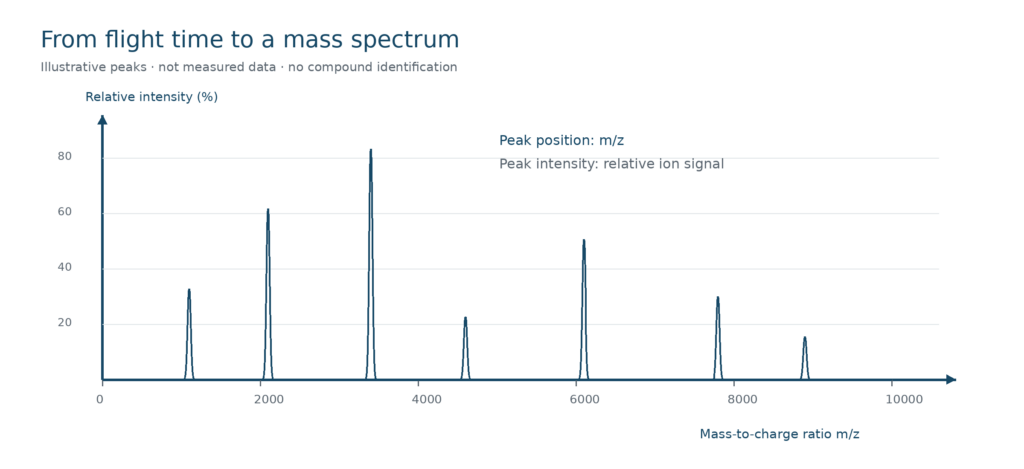
Schematic mass spectrum with illustrative peaks; not measured data and no compound identification.
Identification requires context.
For example, a spectrum can be compared with reference data. Identifying molecules or microorganisms requires appropriate analysis and suitable references.
Where is MALDI-TOF used?

Proteins and peptides
Mass determination and characterisation of biomolecules, for example using characteristic peptide patterns.

Microorganisms
Identification of microorganisms by comparing characteristic spectra with suitable reference databases.

Polymers and materials
Analysis of mass distributions, oligomers and end groups in suitable samples and preparations.
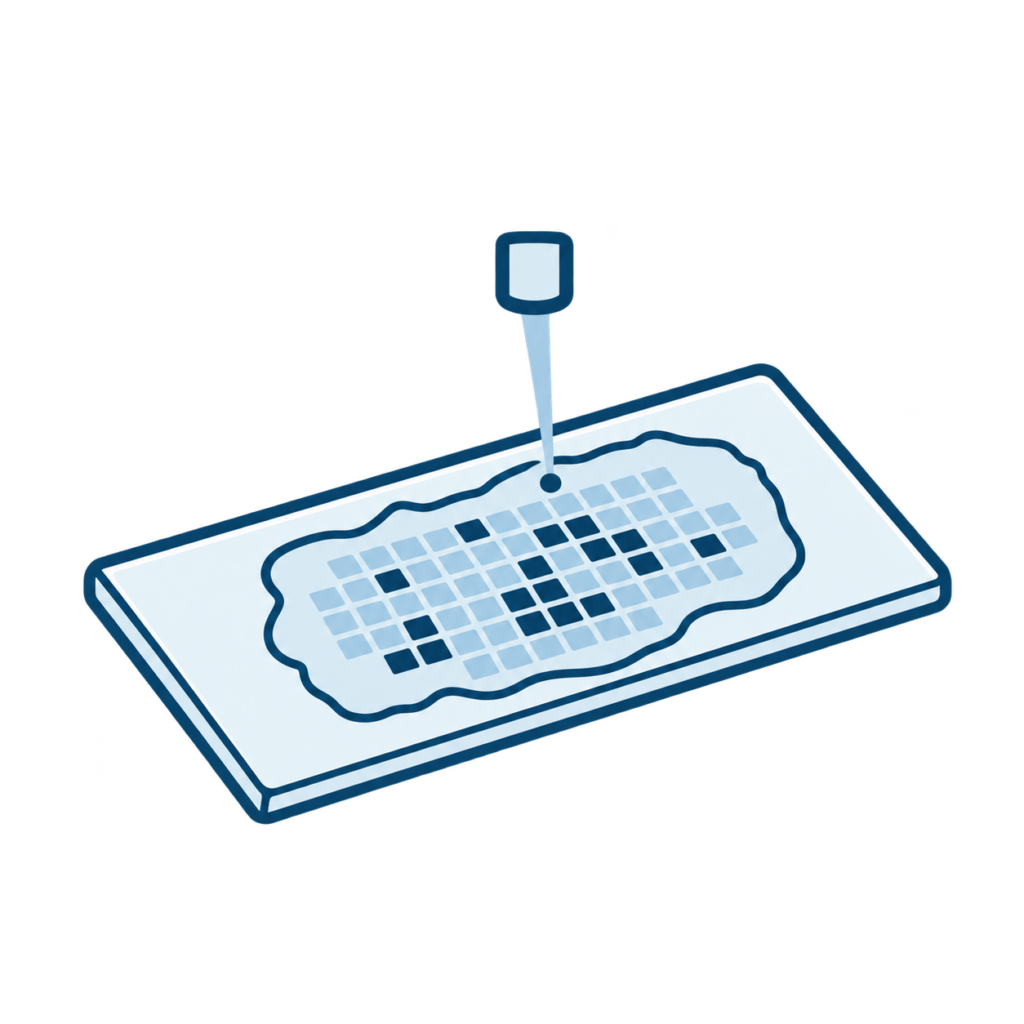
MALDI Imaging
Spatially resolved visualisation of molecular distributions, for example in tissue sections. Mass spectra are acquired point by point.
LTB UV lasers for MALDI-TOF
LTB develops compact pulsed UV lasers for analytical instruments. Nitrogen lasers and diode-pumped solid-state lasers are available for MALDI-TOF. The appropriate configuration depends on the matrix, the required excitation conditions and integration into the instrument.

Nitrogen laser · 337 nm
MNL 100

Compact nitrogen lasers as pulsed UV sources for MALDI-TOF setups. An option for instruments whose optics and measurement sequence are designed for excitation at 337 nm.
The right laser source for your instrument
Are you developing a MALDI-TOF system or looking to replace an existing laser source? Discuss wavelength, pulse energy at the sample, repetition rate, triggering and mechanical interfaces with us.
Frequently asked questions
Why is a matrix used?
A suitable matrix absorbs laser energy, helps transfer the analyte into the gas phase and contributes to ionisation. The matrix and preparation are selected to suit the analyte and the analytical question.
Is higher laser energy always better?
No. Excessive fluence can increase fragmentation and sample removal. The goal is to achieve suitable, reproducible excitation conditions for the desired ion signal.
Can 337 nm, 336 nm and 355 nm be used interchangeably?
Replacing a source requires evaluation of the entire system: matrix absorption, optical coatings, beam profile, pulse duration, fluence and triggering. A similar wavelength alone does not guarantee identical measurement conditions.
What information is helpful for an OEM enquiry?
Useful details include the desired wavelength, pulse energy and spot size at the sample, repetition rate, stability requirements, and information on triggering, available space, beam delivery and interfaces.
All graphics are original, simplified illustrations.