

Detect light elements and add targeted evidence to gemmological assessments.
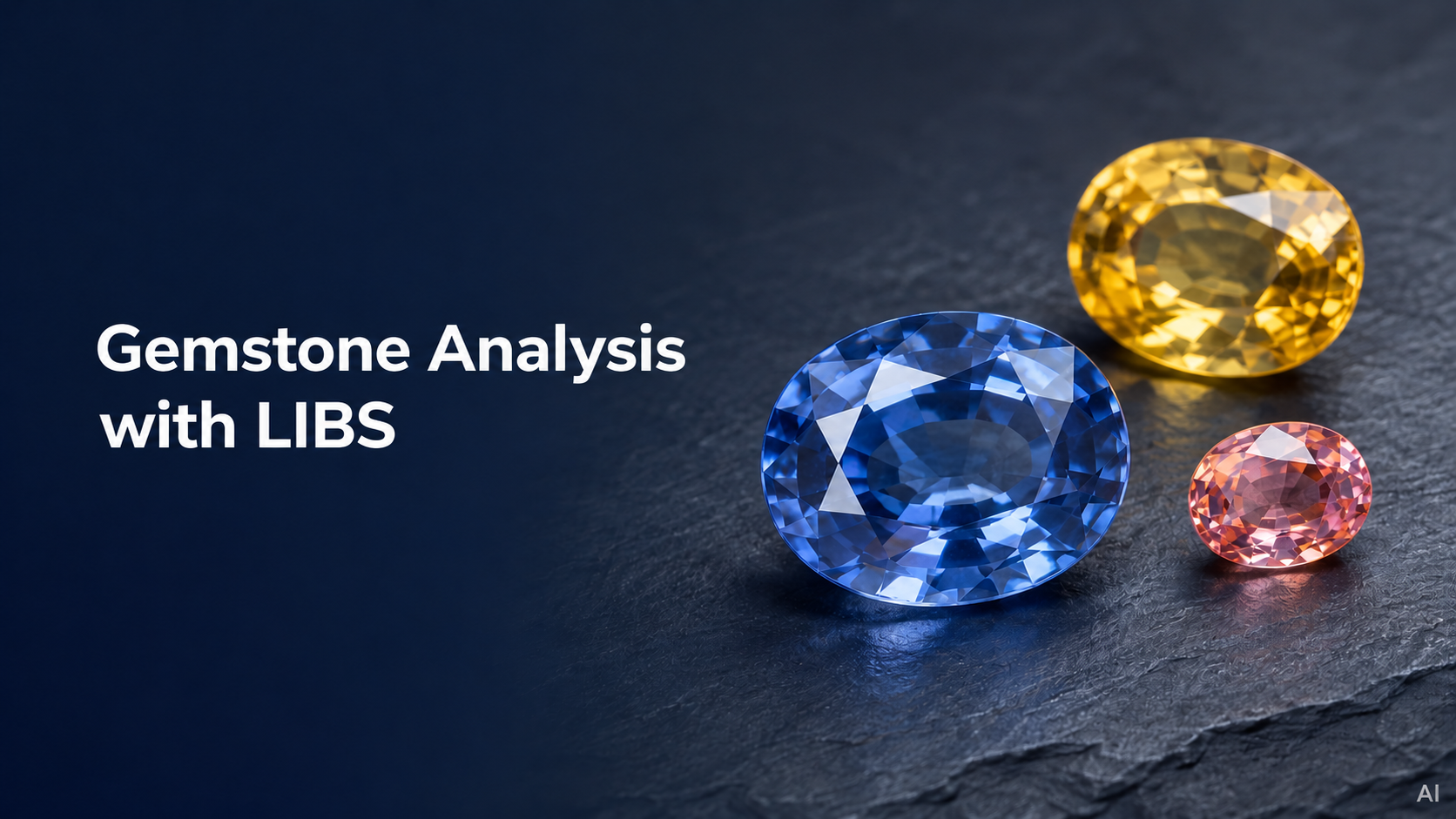
Expand your laboratory’s analytical capabilities with LIBS. The method determines the elemental composition of gemstones at selected measurement sites. It is particularly useful for detecting light elements such as beryllium when investigating diffusion treatments in sapphires.
How does LIBS work?
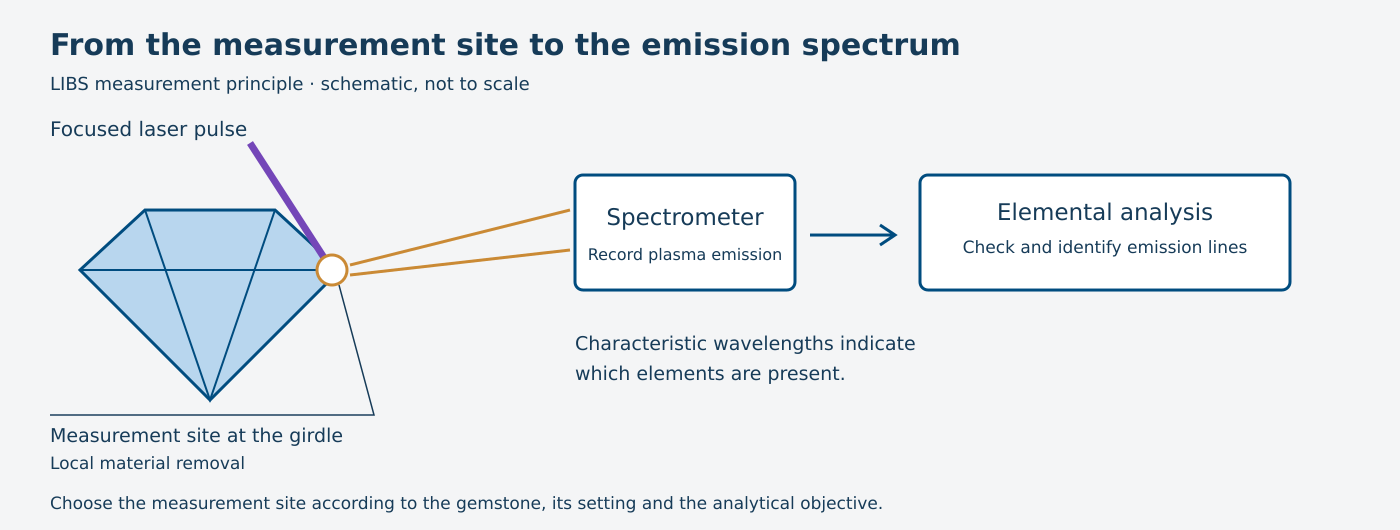
A focused laser pulse generates a microplasma at the gemstone surface. The light emitted by the plasma contains characteristic emission lines that can be used to identify elements. Our introduction explains the measurement principle, system setup and applications in elemental analysis.
What LIBS offers your gemmological laboratory

Detect beryllium in corundum
Test corundum for beryllium to obtain chemical evidence when investigating possible diffusion treatments.
Analyse light elements
Extend your analytical capabilities to elements such as Li, Be and B. Which elements can be detected depends on the measurement setup and the gemstone matrix.
Compare elemental profiles
Compare samples with suitable reference materials and build a reference base for recurring analytical tasks.
Beryllium in sapphires: a key application
Beryllium diffusion can be used to alter the colour of a sapphire. In some cases, microscopy and conventional spectroscopic techniques provide insufficient evidence to determine whether a stone has been treated. LIBS complements gemmological testing by directly detecting beryllium, a light element beyond the reach of conventional EDXRF. [1, 2]
One published study reported LIBS detection of beryllium in corundum down to approximately 2 ppm under its experimental conditions. The detection limit and measurement parameters for your application are determined using suitable standards and representative samples. [1]
Interpreting a beryllium signal
A beryllium signal provides valuable analytical evidence. To assess a possible treatment, consider its concentration and distribution together with other gemmological findings. Naturally occurring beryllium has also been documented in blue sapphires. [3]
Integrating LIBS into your laboratory workflow
1. Select the measurement site
Clean and position the stone. Choose a site suited to the analysis and as inconspicuous as possible, for example on the girdle. Consider accessibility and any setting when planning the measurement.
2. Generate a microplasma
A focused laser pulse removes a small amount of material at the selected site. This creates a short-lived plasma whose emitted light carries information about the elemental composition.
3. Record and check the spectrum
The echelle spectrometer records the plasma emission. Characteristic lines are identified and checked against background signals and suitable control measurements.
4. Document the findings
Interpret the results using reference materials and complementary gemmological tests. Reporting concentrations requires suitable calibration.
When does LIBS complement your existing methods?
LIBS is particularly useful when your laboratory needs to detect light elements and obtain chemical information at selected sites. The application determines which elements to target, the gemstone matrix and the sensitivity required.
| Laboratory task | What LIBS contributes | Complementary approach |
|---|---|---|
| Investigate beryllium in sapphires | Direct detection of Be to support treatment assessment | Microscopy and complementary spectroscopic findings |
| Analyse light elements | Extends the elemental range of conventional EDXRF, particularly for Li, Be and B | EDXRF for additional elemental information |
| Compare samples and references | Spatially resolved elemental profiles provide additional chemical evidence | Reference collection and gemmological expertise |
| Quantify a broad range of elements at very low trace levels | Assess target elements and required detection limits for the application | LA-ICP-MS for more demanding trace element analysis |
Elemental profiles are one part of a comprehensive origin assessment. Their reliability and applicability depend on representative reference data and variation among deposits. LIBS studies on beryl illustrate both the potential of the method and these requirements. [4]
LTB technology for gemstone analysis
Choosing a system for your measurement objectives
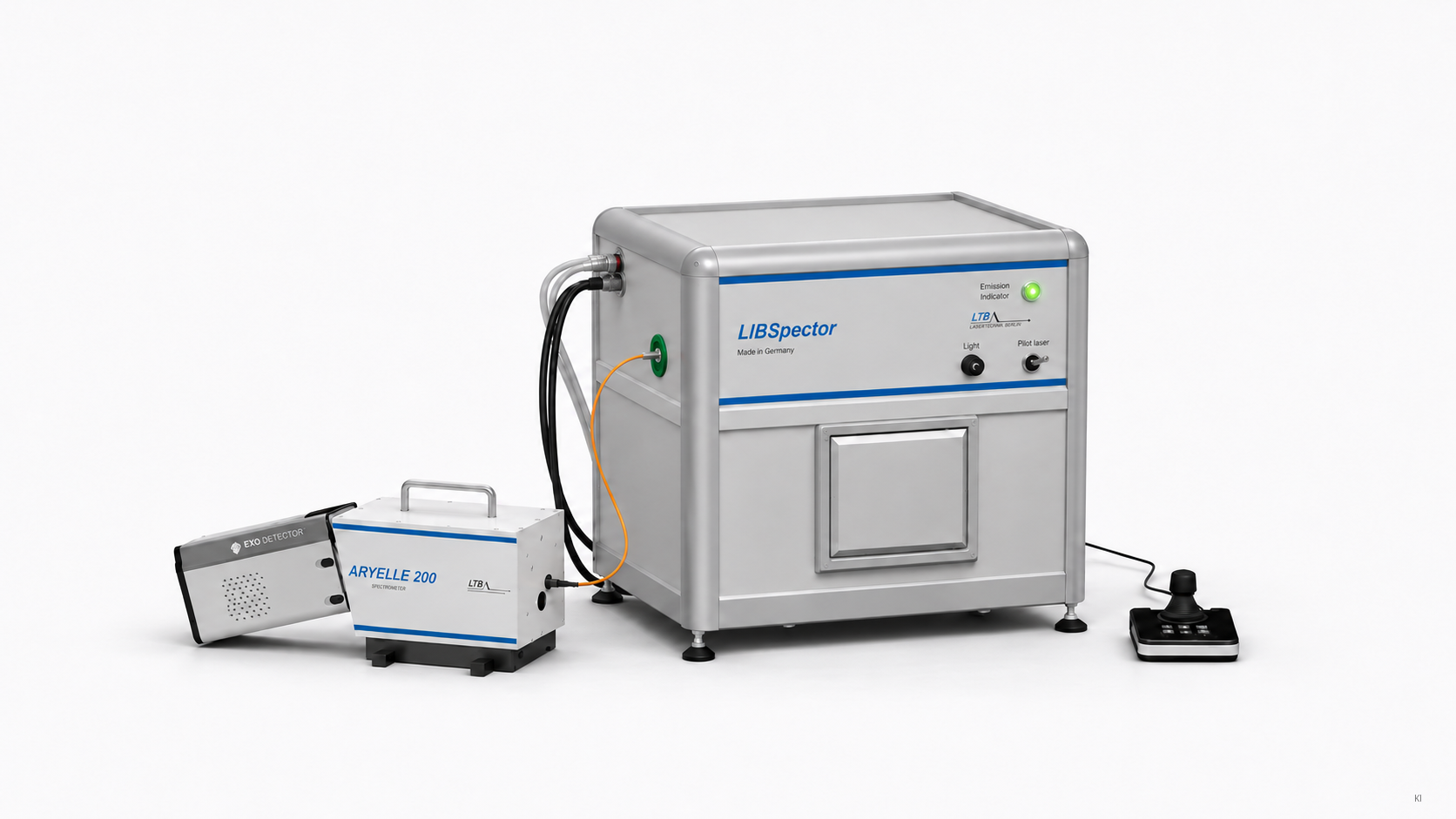
LTB combines LIBS instrumentation with high-resolution echelle spectroscopy. We work with your laboratory to review the target elements, gemstone types, sample positioning and spectral coverage required. These factors guide the system configuration for your application.
The focus is on controlled access to the measurement site, recording the relevant emission lines and a workflow that makes measurements and their interpretation easy to trace.
Instrument illustration based on LTB reference material and created with AI assistance. The equipment configuration is tailored to the application.
Frequently asked questions about LIBS gemstone analysis
Is LIBS non-destructive?
LIBS is microdestructive. It leaves a small ablation crater at the measurement site. Its size and shape depend on the material, focus, pulse energy and number of pulses. The site and parameters are chosen to minimise the impact on the stone.
Does the gemstone require extensive preparation?
In many cases, suitable cleaning, secure mounting and precise positioning are sufficient. Consider the accessible surface and any coatings, residues or settings.
Can LIBS identify every treated or synthetic gemstone?
LIBS provides elemental information for specific analytical questions. Whether that information can indicate a particular treatment or synthetic origin depends on the chemical differences and available reference materials. A final assessment combines findings from several methods.
What detection limit can my laboratory achieve?
The achievable sensitivity depends on the target element, matrix, measurement conditions and data evaluation. We assess these requirements for your application.
Can LIBS provide depth information?
Repeated laser pulses at the same spot can remove successive layers of material. Reliable depth profiles require characterisation of the ablation process and measurement conditions. This approach removes more material.
Extend your laboratory’s analytical capabilities
Do you need to detect beryllium in sapphires or investigate other light elements in gemstones? Tell us which stones and elements you work with and what constraints apply to the measurement site. We can advise you on a suitable LIBS system.
Scientific background
[1] Krzemnicki, Hänni & Walters (2004): A New Method for Detecting Be Diffusion–Treated Sapphires: Laser-Induced Breakdown Spectroscopy (LIBS). Gems & Gemology 40(4), 314–322. DOI: 10.5741/GEMS.40.4.314
[2] GIA (2024): Chemical Analysis in the Gemological Laboratory: XRF and LA-ICP-MS.
[3] GIA (2007): From the GIA Laboratory: Beryllium in Corundum – The Consequences for Blue Sapphire.
[4] McManus et al. (2008): Use of laser induced breakdown spectroscopy in the determination of gem provenance: beryls. Applied Optics 47, G72–G79. DOI: 10.1364/AO.47.000G72